“When arrogance comes, then comes disgrace, but with humility comes wisdom.” -Proverbs 11:2
I haven’t read everything this guy writes on his weekly newsletter, but I like his challenges to all believers who want to dismiss what is happening in our country and to our country. I wish we could all be free to be who God made us to be….free from cruelty and injustice and arrogance. My husband is back in the world of medicine teaching at Thomas A. Frist, Jr. College of Medicine, Belmont University. The thought of losing the respect for the sciences, medical knowledge, libraries, and even the Smithsonian is under attack. It’s beyond belief.
We are living in a time where ignorance has been rebranded as a patriotic virtue.
Where being strong and wrong is admired more than being humble and truthful.
Where arrogance and hostility are treated as more admirable traits in a “leader” than actual education, experience, and humility.
Where the incompetent are put in charge of some of the highest positions of power in our country, positions that will impact millions, and they are met with much fanfare and praise.
Where schools, universities, libraries, and educators are framed as some of the greatest threats to our society rather than our greatest assets.
Where the more education and experience someone has, the less trusted they are by many.
What is most tragic is that some who claim to follow Jesus, some who claim to be people who “stand for the truth,” are among the loudest voices attacking academic discipline, science, and education.
A constant theme throughout the Bible is that humility is the beginning of wisdom and understanding.
“When arrogance comes, then comes disgrace, but with humility comes wisdom.” -Proverbs 11:2
Arrogance and ignorance only leave humanity and the earth exploited and oppressed. Only when we delight in the truth are we truly set free.
If you’re like me, struggling to understand our current U.S. state, commit some time to listening to a Boston College history professor being interviewed by Katie Couric. It’s so clear and concise….and will help you realize where we are.
Friends, if you’re like me…this movement, the New Apostolic Reformation, is fairly unknown to most evangelicals I know. The need to be exposed, first by learning who they are and recognizing their heretical teachings and then embracing the work of defeating what they intend to do to our democracy.
The Army of God Comes Out of the Shadows
February 2025 Issue of the Atlantic
Tens of millions of American Christians are embracing a charismatic movement known as the New Apostolic Reformation, which seeks to destroy the secular state.
On the Thursday night after Donald Trump won the presidential election, an obscure but telling celebration unfolded inside a converted barn off a highway stretching through the cornfields of Lancaster County, Pennsylvania. The place was called Gateway House of Prayer, and it was not exactly a church, and did not exactly fit into the paradigms of what American Christianity has typically been. Inside, there were no hymnals, no images of Jesus Christ, no parables fixed in stained glass. Strings of lights hung from the rafters. A huge map of the world covered one wall. On the others were seven framed bulletin boards, each representing a theater of battle between the forces of God and Satan—government, business, education, family, arts, media, and religion itself. Gateway House of Prayer, it turned out, was a kind of war room. And if its patrons are to be believed, at least one person, and at peak times dozens, had been praying every single minute of every single day for more than 15 years for the victory that now seemed at hand. God was winning. The Kingdom was coming.
“Hallelujah!” said a woman arriving for the weekly 7 o’clock “government watch,” during which a group of 20 or so volunteers sits in a circle and prays for God’s dominion over the nation.
“Now the work begins!” a man said.
“We have to fight, fight, fight!” a grandmother said as they began talking about how a crowd at Trump’s election watch party had launched into the hymn “How Great Thou Art.”
“They were singing that!” another man said.
Yes, people replied; they had seen a video of the moment. As the mood in the barn became ever more jubilant, the grandmother pulled from her purse a shofar, a hollowed-out ram’s horn used during Jewish services. She blew, understanding that the sound would break through the atmosphere, penetrate the demonic realm, and scatter the forces of Satan, a supernatural strike for the Kingdom of God. A woman fell to the floor.
“Heaven and Earth are coming into alignment!” a man declared. “The will of heaven is being done on Earth.”
What was happening in the barn in Lancaster County did not represent some fringe of American Christianity, but rather what much of the faith is becoming. A shift is under way, one that scholars have been tracking for years and that has become startlingly visible with the rise of Trumpism. At this point, tens of millions of believers—about 40 percent of American Christians, including Catholics, according to a recent Denison University survey—are embracing an alluring, charismatic movement that has little use for religious pluralism, individual rights, or constitutional democracy. It is mystical, emotional, and, in its way, wildly utopian. It is transnational, multiracial, and unapologetically political. Early leaders called it the New Apostolic Reformation, or NAR, although some of those same leaders are now engaged in a rebranding effort as the antidemocratic character of the movement has come to light. And people who have never heard the name are nonetheless adopting the movement’s central ideas. These include the belief that God speaks through modern-day apostles and prophets. That demonic forces can control not only individuals, but entire territories and institutions. That the Church is not so much a place as an active “army of God,” one with a holy mission to claim the Earth for the Kingdom as humanity barrels ever deeper into the End Times.
Although the secular establishment has struggled to take all of this seriously, Trump has harnessed this apocalyptic energy to win the presidency twice.
If you were curious why Tucker Carlson, who was raised Episcopalian, recently spoke of being mauled in his sleep by a demon, it may be because he is absorbing the language and beliefs of this movement. If you were questioning why Elon Musk would bother speaking at an NAR church called Life Center in Harrisburg, it is because Musk surely knows that a movement that wants less government and more God works well with his libertarian vision. If you wanted to know why there were news stories about House Speaker Mike Johnson, a Southern Baptist, displaying a white flag with a green pine tree and the words An Appeal to Heaven outside his office, or the same flag being flown outside the vacation home of Supreme Court Justice Samuel Alito, a Catholic, the reason is that the Revolutionary War–era banner has become the battle flag for a movement with ideological allies across the Christian right. The NAR is supplying the ground troops to dismantle the secular state.
And if you are wondering where all of this is heading now that Trump has won the presidency, I was wondering the same thing. That is why I was sitting in the circle at Gateway House of Prayer, where, about 20 minutes into the evening, I got my first clue. People had welcomed me warmly. I had introduced myself as a reporter for The Atlantic. I was taking notes on Earth-heaven alignment when a woman across from me said, “Your writers have called us Nazis.”
She seemed to be referring to an article that had compared Trump’s rhetoric to Hitler’s. I said what I always say, which is that I was there to understand. I offered my spiritual bona fides—raised Southern Baptist, from Alabama. The woman continued: “It’s an editorial board that is severely to the left and despises the Trump movement.” A man sitting next to me came to my defense. “We welcome you,” he said, but it was clear something was off, and that something was me. The media had become a demonic stronghold. The people of God needed to figure out whether I was a tool of Satan, or possibly whether I had been sent by the Almighty.
“I personally feel like if you would like to stay with us, then I would ask if we could lay hands on you and pray,” a woman said.
“We won’t hurt you,” another woman said.
“We just take everything to God,” a woman sitting next to me said. “Don’t take it personally.”
The praying began, and I waited for the judgment.
How all of this came to be is a story with many starting points, the most immediate of which is Trump himself. In the lead-up to the 2016 election, establishment leaders on the Christian right were backing candidates with more pious pedigrees than Trump’s. He needed a way to rally evangelicals, so he turned to some of the most influential apostles and prophets of the NAR, a wilder world where he was cast as God’s “wrecking ball” and embraced by a fresh pool of so-called prophecy voters, people long regarded as the embarrassing riffraff of evangelical Christianity. But the DNA of that moment goes back further, to the Cold War, Latin America, and an iconoclastic seminary professor named C. Peter Wagner.
He grew up in New York City during the Great Depression, and embraced a conservative version of evangelical Christianity when he was courting his future wife. They became missionaries in Bolivia in the 1950s and ’60s, when a wave of Pentecostalism was sweeping South America, filling churches with people who claimed that they were being healed, and seeing signs and wonders that Wagner initially dismissed as heresy. Much of this fervor was being channeled into social-justice movements taking hold across Latin America. Che Guevara was organizing in Bolivia. The civil-rights movement was under way in the United States. Ecumenical organizations such as the World Council of Churches were embracing the theology of liberation, emphasizing ideas such as the social sin of inequality and the need for justice not in heaven but here and now.
In the great postwar competition for hearts and minds, conservative American evangelicals—and the CIA, which they sometimes collaborated with—needed an answer to ideas they saw as dangerously socialist. Wagner, by then the general director of the Andes Evangelical Mission, rose to the occasion. In 1969, he took part in a conference in Bogotá, Colombia, sponsored by the Billy Graham Evangelistic Association that aimed to counter these trends. He wrote a book—Latin American Theology: Radical or Evangelical?—which was handed out to all participants, and which argued that concern with social issues “may easily lead to serving mammon rather than serving God.” Liberation theology was a slippery slope to hell.
After that, Wagner became a professor at Fuller Theological Seminary, teaching in the relatively experimental field of church growth. He began revisiting his experience in Bolivia, deciding that the overflowing churches he’d seen were a sign that the Holy Spirit was working in the world. He was also living in the California of the 1970s, when new religions and cults and a more freewheeling, independent, charismatic Christianity were proliferating, a kind of counter-counterculture. Droves of former hippies were being baptized in the Pacific in what became known as the Jesus People movement. Preachers such as John Wimber, a singer in the band that turned into the Righteous Brothers, were casting out demons before huge crowds. In the ’80s, a group of men in Missouri known as the Kansas City Prophets believed they were restoring the gift of prophecy, understanding this to be God’s natural way of talking to people.
Wagner met a woman named Cindy Jacobs, who understood herself to be a prophet, and believed that the “principalities” and “powers” mentioned in the Book of Ephesians were actually “territorial spirits” that could be defeated through “spiritual warfare.” She and others formed prayer networks targeting the “10/40 window”—a geographic rectangle between the latitudes of 10 and 40 degrees north that included North Africa, the Middle East, and other parts of Asia that were predominantly Muslim, Buddhist, and Hindu.
Wagner also became captivated by a concept called dominionism, a major conceptual shift that had been emerging in conservative theological circles. At the time, the prevailing view was that God’s mandate for Christians was simple evangelism, person by person; the Kingdom would come later, after the return of Jesus Christ, and meanwhile, the business of politics was, as the Bible verse goes, rendered unto Caesar. The new way of thinking was that God was calling his people to establish the Kingdom now. To put it another way, Christians had marching orders—a mandate for aggressive social and institutional transformation. The idea had deep roots in a movement called Christian Reconstructionism, whose serious thinkers—most prominently a Calvinist theologian named R. J. Rushdoony—were spending their lives working out the details of what a government grounded in biblical laws would look like, a model for a Christian theocracy.
By 1996, Wagner and a group of like-minded colleagues were rolling these ideas into what they were calling the New Apostolic Reformation, a term meant to evoke their conviction that a fresh outpouring of the Holy Spirit was moving around the globe, endowing believers with supernatural power and the authority to battle demonic forces and establish God’s Kingdom on Earth. The NAR vision was not technically conservative but radical: Constructing the Kingdom meant destroying the secular state with equal rights for all, and replacing it with a system in which Christianity is supreme. As a practical matter, the movement put the full force of God on the side of free-market capitalism. In that sense, Wagner and his colleagues had found the answer to liberation theology that they’d been seeking for decades.By last year, 42 percent of American Christians agreed with the statement “God wants Christians to stand atop the ‘7 Mountains of Society.’”
Wagner, who died in 2016, wrote dozens of additional books with titles such as Dominion! and Churchquake! The movement allowed Christianity to be changed and updated, embracing the idea that God was raising new apostles and prophets who could not only interpret ancient scripture but deliver “fresh words” and dreams from heaven on a rolling, even daily basis. One of Wagner’s most talented acolytes, a preacher named Lance Wallnau, repackaged the concept of dominionism into what he popularized as the “7 Mountain Mandate,” essentially an action plan for how Christians could dominate the seven spheres of life—government, education, media, and the four others posted on the walls like targets at Gateway House of Prayer.
What happened next is the story of these ideas spreading far and wide into an American culture primed to accept them. Churches interested in growing found that the NAR formula worked, delivering followers a sense of purpose and value in the Kingdom. Many started hosting “7M” seminars and offering coaching and webinars, which often drew wealthy businesspeople into the fold. After the 2016 election, a group of the nation’s ultra-wealthy conservative Christians organized as an invitation-only charity called Ziklag, a reference to the biblical city where David found refuge during his war against King Saul. According to an investigation by ProPublica, the group stated in internal documents that its purpose was to “take dominion over the Seven Mountains.” Wallnau is an adviser.
By last year, 42 percent of American Christians agreed with the statement “God wants Christians to stand atop the ‘7 Mountains of Society,’ ” according to Paul Djupe, a Denison University political scientist who has been developing new surveys to capture what he and others describe as a “fundamental shift” in American Christianity. Roughly 61 percent agreed with the statement that “there are modern-day apostles and prophets.” Roughly half agreed that “there are demonic ‘principalities’ and ‘powers’ who control physical territory,” and that the Church should “organize campaigns of spiritual warfare and prayer to displace high-level demons.”
Overall, Djupe told me, the nation continues to become more secular. In 1991, only 6 percent of Americans identified as nonreligious, a figure that is now about 30 percent. But the Christians who remain are becoming more radical.
“They are taking on these extreme beliefs that give them a sense of power—they believe they have the power to change the nature of the Earth,” Djupe said. “The adoption of these sort of beliefs is happening incredibly fast.”
The ideas have seeped into Trumpworld, influencing the agenda known as Project 2025, as well as proposals set forth by the America First Policy Institute. A new book called Unhumans, co-authored by the far-right conspiracy theorist Jack Posobiec and endorsed by J. D. Vance, describes political opponents as “unhumans” who want to “undo civilization itself” and who currently “run operations in media, government, education, economy, family, religion, and arts and entertainment”—the seven mountains. The book argues that these “unhumans” must be “crushed.”
“Our study of history has brought us to this conclusion: Democracy has never worked to protect innocents from the unhumans,” the authors write. “It is time to stop playing by rules they won’t.”
my own frame of reference for what evangelical Christianity looked like was wooden pews, the ladies’ handbell choir, and chicken casseroles for the homebound. The Southern Baptists of my childhood had no immediate reason to behave like insurgents. They had dominated Alabama for decades, mostly blessing the status quo. When I got an assignment a few years ago to write about why evangelicals were still backing Trump, I mistakenly thought that the Baptists were where the action was on the Christian right. I was working for The Washington Post then, and like many journalists, commentators, and researchers who study religion, I was far behind.
Where I ended up one Sunday in 2021 was a church in Fort Worth, Texas, called Mercy Culture. Roughly 1,500 people were streaming through the doors for one of four weekend services, one of which was in Spanish. Ushers offered earplugs. A store carried books about spiritual warfare. Inside the sanctuary, the people filling the seats were white, Black, and brown; they were working-class and professionals and unemployed; they were former drug addicts and porn addicts and social-media addicts; they were young men and women who believed their homosexual tendencies to be the work of Satan. I met a young woman who told me she was going to Montana to “prophesy over the land.” I met a young man contemplating a future as a missionary, who told me, “If I have any choice, I want to die like the disciples.” They had the drifty air of hippies, but their counterculture was pure Kingdom.
They faced a huge video screen showing swirling stars, crashing waves, and apocalyptic images, including a mushroom cloud. A digital clock was counting down, and when it hit zero, a band—keyboard, guitars, drums—began blasting music that reminded you of some pop song you couldn’t quite place, from some world you’d left behind when you came through the doors. Lights flashed. Machine-made fog drifted through the crowd. People waved colored flags, calling the Holy Spirit in for a landing. Cameras swooped around, zooming in on a grown man crying and a woman lying prostrate, praying. Eventually, the pastor, a young man in skinny jeans, came onstage and demon-mapped the whole city of Fort Worth. The west side was controlled by the principality of Greed, the north by the demonic spirit of Rebellion; the south belonged to Lust. He spoke of surrendering to God’s laws. And at one point, he endorsed a Church elder running for mayor, describing the campaign as “the beginning of a righteous movement.”
Walking across the bleak, hot parking lot to my rental car afterward, I could understand how people were drawn into their realm. After that, I started seeing the futuristic world of the NAR all over the place. Sprawling megachurches outside Atlanta, Phoenix, and Harrisburg with Broadway-level production values; lower-budget operations in strip malls and the husks of defunct traditional churches. Lots of screens, lots of flags. Conferences with names like Open the Heavens. A training course called Vanquish Academy where people could learn “advanced prophetic weaponry” and “dream intelligence.” Schools such as Kingdom University, in Tennessee, where students can learn their “Kingdom Assignment.” In a way, the movement was a world with its own language. People spoke of convergence and alignment and demon portals and whether certain businesses were Kingdom or not.
In 2023, I met a woman who believed that her Kingdom assignment was to buy an entire mountain for God, and did. It is in northwestern Pennsylvania, and she lives on top of it with her husband. They are always finding what she called “God signs,” such as feathers on the porch. Like many in the movement, she didn’t attend church very often. But every day, she followed online prophets and apostles such as Dutch Sheets, an acolyte of Wagner’s who has hundreds of thousands of followers and is known for interpreting dreams.
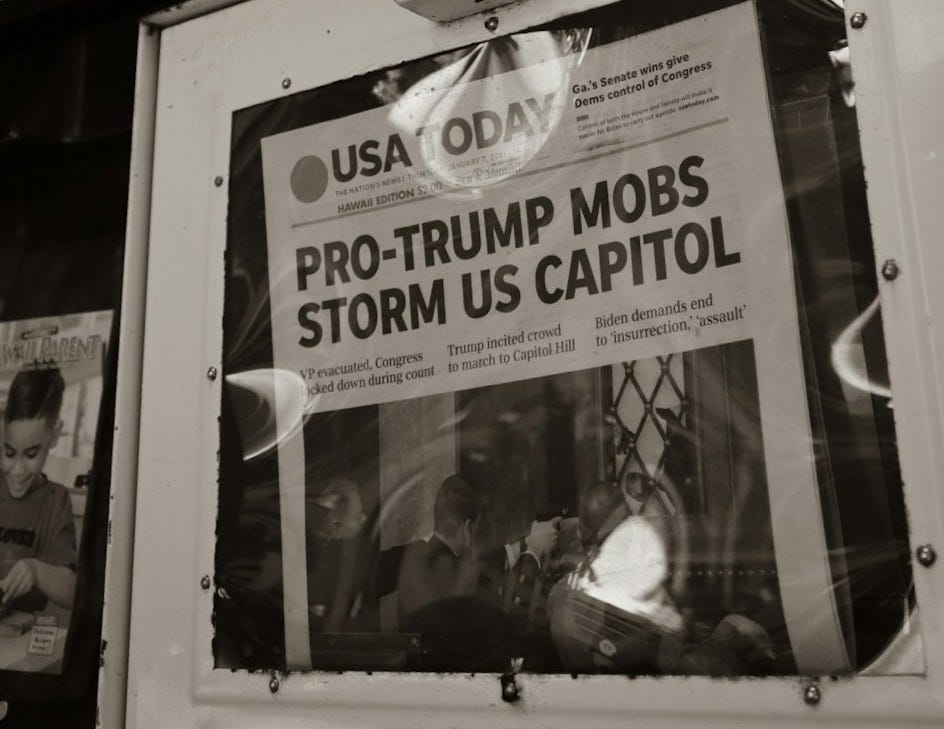
In 2016, Sheets began embracing prophecies that God was using Trump, telling fellow prophets and apostles that his victory would bring “new levels of demonic desperation.” In the aftermath of the 2020 election, Sheets began releasing daily prophetic updates called Give Him 15, casting Trump’s attempt to steal the election as a great spiritual battle against the forces of darkness. In the days before the insurrection, Sheets described a dream in which he was charging on horseback to the U.S. Capitol to stand for the Kingdom. Although he was not in Washington, D.C., on January 6, many of his followers were, some carrying the APPEAL TO HEAVEN flag he’d popularized. Others from Wagner’s old inner circle were there too. Wallnau streamed live from near the U.S. Capitol that day and, that night, from the Trump International Hotel. Cindy Jacobs conducted spiritual warfare just outside the Capitol as rioters were smashing their way inside, telling her followers that the Lord had given her a vision “that they would break through and go all the way to the top.” In his most recent book, The Violent Take It by Force, the scholar Matthew Taylor details the role that major NAR leaders played that day, calling them “the principal theological architects” of the insurrection.
At the Pennsylvania statehouse, I met an apostle named Abby Abildness, whom I came to understand as a kind of Kingdom diplomat. It was the spring of 2023, and she had recently returned from Iraqi Kurdistan, where she had met with Kurdish leaders she believed to be descended from King Solomon, and who she said wanted “holy governance to go forth.”
I watched YouTube videos of prophets broadcasting from their basements. I watched a streaming show called FlashPoint, where apostles and prophets deliver news from God; guests have included Israeli Prime Minister Benjamin Netanyahu, because another dimension of the NAR is that the movement is a prominent advocate of Christian Zionism.
I came to understand how the movement amounts to a sprawling political machine. The apostles and prophets, speaking for God, decide which candidates and policies advance the Kingdom. The movement’s prayer networks and newsletters amount to voter lists and voter guides. A growing ecosystem of podcasts and streaming shows such as FlashPoint amounts to a Kingdom media empire. And the overall vision of the movement means that people are not engaged just during election years but, like the people at Gateway House of Prayer, 24/7.
As November’s election neared, I watched the whole juggernaut crank into action to return Trump to the White House. Wallnau, in partnership with the Trump-aligned America First Policy Institute, promoted an effort called Project 19, targeting voters in 19 swing counties. He also launched something called the Courage Tour, which similarly targeted swing states, and I attended one event in Eau Claire, Wisconsin. It looked like an old-fashioned tent revival, except that it was also an aggressive pro-Trump mobilization effort. Wallnau dabbed frankincense oil onto foreheads, anointing voters into God’s army. Another speaker said that Kamala Harris would be a “devil in the White House.” Others cast Democrats as agents of Lucifer, and human history as a struggle between the godless forces of secular humanism and God’s will for humankind.
A march called “A Million Women” on the National Mall drew tens of thousands of people and culminated with the smashing of an altar representing demonic strongholds in America. With the Capitol dome as their backdrop, people took turns bashing the altar as music surged and others prayed, and when it was rubble, the prophet Lou Engle declared, “We’re going to point to the north, south, and east, and west, and command America! The veil has been ripped!”
The NAR movement was a major source of the “low-propensity voters” who backed Trump. Frederick Clarkson, a senior research analyst with Political Research Associates, which tracks antidemocratic movements, has been documenting the rise of the NAR for years, and warning about its theocratic goals. He believes that a certain condescension, and perhaps failure of imagination, has kept outsiders from understanding what he has come to see as the most significant religious movement of the 21st century, and one that poses a profound threat to democracy.
“Certain segments of society have not been willing to understand where these people are coming from,” Clarkson told me. “For me, it’s part of the story of our times. It’s a movement that has continued to rise, gathered political strength, attracted money, built institutions. And the broad center-left doesn’t understand what’s happening.”
Which leaves the question of what happens now.
The movement certainly aligns with many goals of the Christian right: a total abortion ban, an end to gay marriage and LGBTQ rights. Traditional family is the fundamental unit of God’s perfect order. In theory, affirmative action, welfare programs, and other social-justice measures would be unnecessary because in the Kingdom, as Abildness, the Pennsylvania apostle, and her husband once explained to me, there is no racism and no identity other than child of God. “Those that oppose us think we are dangerous,” her husband told me, describing a vision of life governed by God’s will. “But this is better for everyone. There wouldn’t be homelessness. We’d be caring for each other.”
Matthew Taylor told me he sees the movement merging seamlessly into “the MAGA blob,” with the prophets and apostles casting whatever Trump does as part of God’s plan, and rebuking any dissent. “It’s the synchronization with Trump that is most alarming,” he said. “The agenda now is Trump. And that’s how populist authoritarianism works. It starts out as a coalition, as a shotgun marriage, and eventually the populism and authoritarianism takes over.”
In another sense, the movement has never been about policies or changes to the law; it’s always been about the larger goal of dismantling the institutions of secular government to clear the way for the Kingdom. It is about God’s total victory.
“Buckle up, buttercup!” Wallnau said on his podcast shortly after the election. “Because you’re going to be watching a whole new redefinition of what the reformation looks like as Christians engage every sector of society. Christ is not quarantined any longer. We’re going into all the world.”
On the day after the election, I went to Life Center, the NAR church where Elon Musk had spoken a couple of weeks earlier. The mood was jubilant. A pastor spoke of “years of oppression” and said that “we are at a time on the other side of a victory for our nation that God alone—that God alone—orchestrated for us.”
The music pounded, and people cheered, and after that, a prominent prophet named Joseph Garlington delivered a sermon. He was a guest speaker, and he offered what sounded like the first hint of dissent I’d heard in a long time. He talked about undocumented immigrants and asked people to consider whether it might be possible that God was sending them to the U.S. so they could build the Kingdom.
“What if they are part of the harvest?” he said. “He didn’t send us to them; maybe he’s sending them to us.”
It was a striking moment. Life Center, Mercy Culture, and many other churches in the movement have large numbers of Latinos in their congregations. In 2020, Trump kicked off his outreach to evangelical voters at a Miami megachurch called El Rey Jesús, headed by a prominent Honduran American apostle named Guillermo Maldonado. I wondered how the apostles and prophets would react to the mass deportations Trump had proposed. Garlington continued that Trump was “God’s choice,” but that the election was just one battle in the ultimate struggle. He told people that it’s “time for war,” language I kept hearing in other NAR circles even after the election. He told people to prepare to lose friends and family as the Kingdom of God marched on in the days ahead. He told them to separate from the wicked.“You’ll be happy with the changes God brings,” a woman reassured me. “You’ll be happy.”
“If you’ve got a child and he says, ‘Come and let us go serve other gods,’ go tell on him. Tell them, ‘I’ve got a kid who is saying we need to serve other gods. Can you help me kill him?’ ” Garlington said he wasn’t being literal about the last part. “But you need to rebuke them,” he said. “You need to say, ‘Honey, if you keep on that path, there’s a place reserved in hell for you.’ ”
This was also a theme the next day at Gateway House of Prayer, where I waited to learn my own fate, as people began praying in tongues and free-forming in English as the Holy Spirit gave them words.
Alexandre Luu
“We’re asking for a full overturning in the media,” a man said. “We’re asking for all the media to turn away from being propagandists to being truth tellers.”
“Their eyes need to be opened,” a woman said. “They don’t know God at all. They think they know all these things because they’re so educated and worldly. But they do not see God … And that’s what we need. The harvest.”
“The reformation,” the grandmother added.
“The reformation,” the woman said.
At one point, a man questioned me: “The whole world knows The Atlantic is a left-wing, Marxist-type publication. Why would you choose to go and work there?” At another point, the group leader defended me: “I feel the Lord has called her to be a truth seeker.” At another point, the grandmother spoke of a prophecy she’d heard recently about punishment for the wicked. “There are millstones being made in Heaven,” she said. “Straight up. There’s millstones.” Another woman spoke of “God’s angry judgment” for the disobedient.
“There’s a lot of people that are going to change their minds,” a man said.
“You’ll be happy with the changes God brings,” a woman reassured me. “You’ll be happy.”
This went on for a while. I wasn’t sure where it was going until the leader of the group decided that I should leave. She could not have been nicer about it. She spoke of God’s absolute love, and absolute truth, and absolute justice, and then I headed for the door.
A few women followed me into the lobby, apologizing that it had come to this. They were sorry for me, as believers in the movement were sorry for all of the people who were lost and confused by this moment in America—the doubters, the atheists, the gay people, Muslims, Buddhists, Democrats, journalists, and all the godless who had not yet submitted to what they knew to be true. The Kingdom was here, and the only question was whether you were in, or out.
This article appears in the February 2025 print edition with the headline “Army of God.”
Volunteer with local ministries. Grow in compassion for those under-resourced in your area. Match your personal passion with a need. There may some ministries that offer child-friendly opportunities. If you are not sure what is out there, begin by looking at a large church’s webpages for many vetted local ministries. World Relief may be in your city. Teaching English as a Second Language is one way that is so very important in caring for immigrants and refugees. [If you find yourself lacking in empathy for those with needs, challenge yourself to understand that empathy comes with close proximity. You won’t comprehend this until you are closer to those who need your care and love.]
Invite people of different ethnicities to your home. Welcome a new international family into your neighborhood or school with something freshly baked. Invite an international family to teach you to cook some of their favorite ethnic foods. Reach out to immigrant school-aged children with an invitation to a church event or a game or a playdate [which can create confidence and compassion in a child.] Learn about the people group that they are a part of.
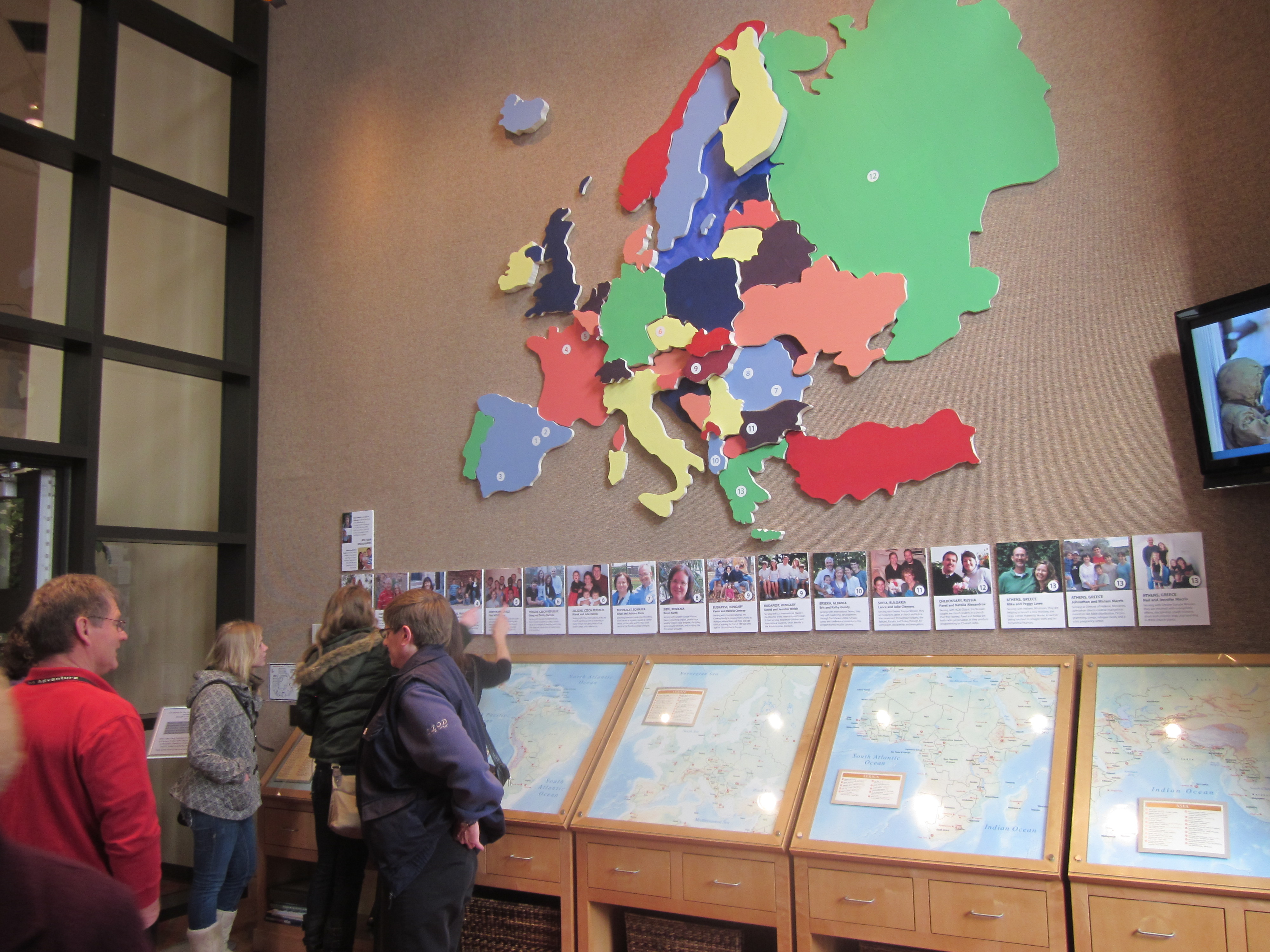
Learn more about different countries in the world that you know little about. Have helpful things around you like decorating with a globe or purchasing table placemats with a world map to use at dinner, especially with children. Purchase a cloth map (on Pinterest) for easy put up and take down or find an important place to display a world map in your home. Play games with these tools. Talk about some country in the news and find the location on a map (maybe an earthquake or a conflict). Some people pray for the country on your clothing label. Make a country your weekly or monthly focus for prayer. Explore short-term mission trips for you or your child.
Sponsor a child overseas. Child sponsorship is a wonderful introduction to caring about the world. You may find a young child that is the age of your own child or grandchild and support them all the way through their school years as most of these funds pay for school fees. You can write to them. National organizations like Compassion International or World Vision are both reliable and honest Christian organizations through which to sponsor a child.
Become an email/pen pal with a missionary. Read a blog of a missionary family together after dinner. Write to them and ask questions about their life. Give regular financial support to a missionary. Don’t forget to talk about giving with your children/grandchildren. They can understand supporting a missionary at a young age and experience the relationship you have with this family.
Revisit some challenging scriptures that God will use to motivate you and also teach your children what God says about the world. In a very ethnocentric time in the life of our country, it will be important to remind ourselves of our command to love and our commission to reach out and share the gospel with those who have never heard.
Key words from Scripture about God’s view of the world.:
1 Chronicles 16:24 Declare his glory among the nations, his marvelous deeds among all peoples.
Matthew 22:36-40 The Greatest Commandments Jesus replied: Love the Lord your God with all your heart and with all your soul and with all your mind. This is the first and greatest commandment. And the second is like it: Love your neighbor as yourself. All the Law and the Prophets hang on these two commandments.
Matthew 28:18-20The Great Commission Then Jesus came to them and said, All authority in heaven and on earth has been given to me. Therefore go and make disciples of all nations, baptizing them in the name of the Father and of the Son and of the Holy Spirit, and teaching them to obey everything I have commanded you. And surely I am with you always, to the very end of the age.
John 20:21 Jesus said, As the Father has sent me, I am sending you.
Acts 1:8 But you will receive power when the Holy Spirit has come on you; and you will be my witnesses in Jerusalem, in all Judea and Samaria, and to the ends of the earth.
Romans 10:13 -15 For everyone who calls on the name of the Lord will be saved. How then can they call on the one they have not believed in?… And how can they believe in the one of whom they have not heard? And how can they hear without someone preaching to them? And how can anyone preach unless they are sent? As it is written: “How beautiful are the feet of those who bring good news!”
II Corinthians 5:17-20 Therefore, if anyone is in Christ, the new creation has come:[a] The old has gone, the new is here! All this is from God, who reconciled us to himself through Christ and gave us the ministry of reconciliation: that God was reconciling the world to himself in Christ, not counting people’s sins against them. And he has committed to us the message of reconciliation. We are therefore Christ’s ambassadors, as though God were making his appeal through us. We implore you on Christ’s behalf: be reconciled to God.
January 1 will find us twenty days away from Donald Trump’s inauguration—a moment when we will begin to learn what happens when he is president, again. But we already know some of what to expect from his administration, much of which directly contradicts promises he made not so long ago.
As you may recall, Trump has consistently presented himself as a deficit hawk (despite all evidence). With this supposedly in mind, he enlisted Elon Musk and Vivek Ramaswamy to create a Department of Government Efficiency, tasked with examining federal spending and finding ways to cut large portions. In less time than it takes to say “entitlements, defense, and interest payments,” they estimated that $2 trillion could be slashed from a total budget of just over $6.75 trillion.
Entitlements, defense, and interest payments are worth noting because this spending is essentially locked into future budgets. For entitlements, including Social Security and Medicare for seniors (who vote in high numbers), the figure is $2.3 trillion. Think this can be cut? Think again. In the same budget, the Pentagon receives nearly $875 billion. This figure needs to rise as it is not even keeping up with inflation and growth in military salaries. And interest on the national debt? This consumes almost $1 Trillion annually (More than defense spending). Is Trump inclined to limit the debt that accrues this interest? Consider his recent demand to remove the debt ceiling entirely, and you have your answer.
Okay, you might say, Trump lied about his plan for deficits and federal spending. Every candidate overpromises. Surely, he’ll follow through on his most prominent campaign promise: limiting immigration, rounding up those here illegally, and deporting them by the millions. Right?
Well, maybe not.
Despite Trump’s rhetoric about criminal immigrants and their impact on American jobs, his administration faces significant practical hurdles. They would need to locate, apprehend, detain, process, and deport these individuals through the legal system. How many people are we talking about? Estimates suggest as many as 13 million—about 4% of the U.S. population.
The staggering logistical challenges, legal obstacles, and costs associated with this mass deportation plan have already prompted incoming officials to concede that Trump’s promise may not be feasible. Sure, they might double the number of people Biden deported last year—270,000—but millions every year for four years? That’s a pipe dream. The saying about pigs flying comes to mind.
In foreign affairs, Trump is also backing away from another bold promise: ending Russia’s war against Ukraine on his first day in office. In recent remarks, he admitted that stopping the war in Ukraine may actually be more difficult than ending Israel’s war on Hamas in Gaza. “I see that as more difficult,” he confessed. So much for his self-proclaimed brilliance in diplomacy or his “special relationship” with Vladimir Putin. In a way this maybe good, if it means Trump actually tries a fair negotiation instead of selling Ukraine out. Color me very skeptical.
Elsewhere, the man who vowed to keep the U.S. out of international conflicts seems intent on creating them. Trump has floated the idea of taking over the Panama Canal and purchasing Greenland, a semi-autonomous Danish territory.
The Panama Canal was built by the United States and operated as an American facility in the U.S. Canal Zone from 1903 to 1979, when a treaty began transferring control to Panama. The process was completed in 1999. Trump now deems the transit fees Panama charges as exorbitant and has suggested “taking the canal back.” Since the treaty is inviolable, one must ask: is the man who promised to keep us out of war willing to start one over this issue?
The Greenland idea is even more outlandish. As Trump explained, during his first term, a wealthy GOP donor casually mentioned the notion. Trump, intrigued, looked at a world map through the lens of a real estate developer and began entertaining the idea of owning the largest island in the world. With Trump’s defeat in 2020, the concept faded away. Now it has returned, zombie-like, to haunt his agenda.Let’s be honest though, he is simply blustering to LOOK tough, since he is scared to death to confront America’s real enemies. Instead, he provokes wars of words with our friends as a strawman. It’s a move as old as government itself.
Of course, Greenland is not for sale, and even Trump is unlikely to send troops to Panama. However, like his troubles with deportations, his newfound pessimism about Ukraine, and his budget and deficit blunders, the absurdity of these ideas underscores one point: even before taking office, Trump is proving that his campaign promises were made to be broken. One wonders if his supporters have even noticed, or even care.
This story happened December 1990…a family favorite that happened to us.
By Jim Judge
One Christmas our family shared in a kind of small Christmas miracle.
Some good friends of ours, Bill and Mary Beauvais and their three children were working as full time missionaries in Africa. They were in the midst of a severe time. Gabon was in economic crisis and so were they. Their financial support level was running low, partially a result of the Gulf War and its impact on the value of the dollar and Bill and Mary were struggling to provide even the essentials, sometimes having to make hard choices between things like medical care for a child and the next meal. With Christmas approaching Bill and Mary watched helplessly as they saw their children moving fast toward a head-on collision with disappointment. They were facing Christmas with no gifts whatsoever? It was starting to get to them.
“Tis a gift to be simple,” as the old Shaker hymn says, a gift afforded to many children, but few adults. Three weeks before Christmas, their four-year-old son, Ryan, spotted the one thing he wanted in an old magazine and he did what 4 year olds are particularly good at – he obsessed. No question about it. Santa Claus was going to bring him what he saw in that advertisement. It was a small dinosaur, a small pink brontosaurus. Mary winced everytime he brought it up which was about 30 times a day because she knew this was an impossible item really. First of all the magazine was three years old and the item was not even for sale, it was a give-away at a fast food chain. And oh, by the way, they were sitting smack in the middle of equatorial Africa! Mary tried to distract him as best she could, even going so far as to hide the magazine, but it was of no use. Ryan had fixated on it. A pink dinosaur was what he kept talking about, he was sure a pink dinosaur was going to be waiting for him that Christmas. It’s one thing to hold to your parent principles that gifts aren’t the true meaning of Christmas. Try explaining that profound theological truth to an empty-handed 4 year old little boy on Christmas morning.
Bill and Mary tried to think of other things. When the Friday before Christmas came around, their neighbors stopped by city post office in the center of town and brought back a notice that there was a package there waiting for the Bill and Mary. The problem was that the post office was way across town, Bill and Mary didn’t even have enough money for the bus ride into town let alone whatever customs might be assessed. They told themselves it probably didn’t matter anyway, government offices have a way of closing way before the posted hours in Africa, particularly before a holiday and the package was likely just some ministry materials like books or supplies. But their neighbors said they would be going back by the post office later that afternoon and just in case it was still open, they would stop in and check.
It was 5:25 PM when their neighbors arrived at the post office, which was scheduled to close at 5:30PM. There was no one there except one lone worker who didn’t look all that official, sort of leaning on a broom, pretending to be cleaning up. They handed him the slip signed by the Beauvais’. Wordlessly He disappeared into the back room and in short order, came out with a large package and simply handed it over. The return address was Jim and Cindy Judge, Wheaton, Illinois and the postmark was February. My wife Cindy had sent the box of items in response to a request Mary had made in a letter almost a year earlier, asking mostly for some unglamorous but unavailable items like a new mop head, a home permanent, and some tile grout. Cindy, taking seriously Mary’s admonition not to spend a lot on postage, had sent the big boot box via surface mail and the post office apparently took the word “surface” literally. It must have been rowed across the Atlantic. Where the box had spent the last 10 months was anyone’s guess. While putting the package together Cindy, as she is so wont to do, also included several other unspecified items: some new clothing for the children, music tapes, books, dolls and fun things from around our house. She found lots of things for Ryan’s ten and eight year old sisters, who were about the same age as our girls, but nothing seemed very appropriate for a 4-year-old little boy.
Just before closing the package, one item in our toybox caught Cindy’s eye. It was a long discarded toy from a Burger King Happy Meal, something we had gotten several years before. It was a toy promoting the animated film The Land Before Time. It was a dinosaur….a brontosaurus, a pink brontosaurus to be exact. Cindy tucked it deeply into the bottom of the box and hoped it would do.
Ten months later, alone in their bedroom on Christmas Eve, Mary and Bill unpacked that box from the Judges. Item by item, they were overwhelmed by the things inside. There was something special for everyone, everyone it seemed except for Ryan. But when they reached the bottom and pulled out that last item, that pink dinosaur, that one thing utterly impossible to deliver, that thing no adult would have been foolish enough to even consider praying for, they were stunned. It was a true gift from the “other” list, that other list, the list we all keep secret and safe inside, the one we have all made in one way or another, if only in our hearts. The list with those desires too unreasonable, too costly, too extravagant, too, in a word, dear to even risk mentioning. Yet sometimes, some very special times, an item from the other list appears. And when it does we know we are dearly loved.
Mary and Bill held the pink dinosaur in their hands and were speechless. Ten months before their son had even seen its picture in an old magazine, some friend thousands of miles away had placed it in a box, a box that was delayed and sat waiting for that one exact best possible moment to reappear. Tears ran down their faces. Was it all the product of time and chance? Some happy coincidence? A momentary look beyond the shadowlands of our everyday world. As they stared down at the toy they knew their answer…this gift required so much knowing, so much care, so much attention that it was as if the curtain had been drawn back and they had been given their own gift…. a sweet glimpse of the Savior’s smiling face… and they were dazzled.
It wasn’t a very big miracle. No one ended poverty, received a million dollars or saved a life. It was a small item really. But if Christmas speaks any truth it tells us this…..the best of God’s Christmas gifts, the greatest of Christmas miracles….comes wrapped humbly…in a small bundle.
I have repressed so much of my desire to influence “the undecided” before this election with the great articles and authors I am reading. But today I feel the need to express some things through one of my favorite writers with whom I resonate.
She is the history professor, Heather Cox Richardson, an American historian born in Chicago. She is a baby-boomer and loves this country. Her Letters from an American have been among my favorite non-journalist writers for years. She is a professor of history at Boston College, where she teaches courses on the American Civil War, the Reconstruction Era, the American West, and the Plains Indians. She is a Harvard graduate and previously taught history at MIT and the University of Massachusetts Amherst.
Yesterday, November 5, 2024, Americans reelected former president Donald Trump, a Republican, to the presidency over Democratic candidate Vice President Kamala Harris. As of Wednesday night, Trump is projected to get at least 295 electoral votes to Harris’s 226, with two Republican-leaning states still not called. The popular vote count is still underway.
Republicans also retook control of the Senate, where Democrats were defending far more seats than Republicans. Control of the House is not yet clear.
These results were a surprise to everyone. Trump is a 78-year-old convicted felon who has been found liable for sexual assault and is currently under indictment in a number of jurisdictions. He refused to leave office peacefully when voters elected President Joe Biden in 2020, instead launching an unprecedented attack on the U.S. Capitol to stop the counting of electoral votes, and said during his campaign that he would be a “dictator” on his first day in office.
Pollsters thought the race would be very close but showed increasing momentum for Harris, and Harris’s team expressed confidence during the day. By posting on social media—with no evidence—that the voting in Pennsylvania was rigged, Trump himself suggested he expected he would lose the popular vote, at least, as he did in 2016 and 2020.
But in 2024, it appears a majority of American voters chose to put Trump back into office.
Harris and her running mate, Minnesota governor Tim Walz, offered a message of unity, the expansion of the economic policies that have made the U.S. economy the strongest in the world in the wake of the coronavirus pandemic, and the creation of an “opportunity economy” that echoed many of the policies Republicans used to embrace. Trump vowed to take revenge on his enemies and to return the country to the neoliberal policies President Joe Biden had rejected in favor of investing in the middle class.
When he took office, Biden acknowledged that democracy was in danger around the globe, as authoritarians like Russian president Vladimir Putin and China’s president Xi Jinping maintained that democracy was obsolete and must be replaced by autocracies. Russia set out to undermine the North Atlantic Treaty Organization (NATO) that enforced the rules-based international order that stood against Russian expansion.
Hungarian prime minister Viktor Orbán, who overturned democracy in his own country, explained that the historical liberal democracy of the United States weakens a nation because the equality it champions means treating immigrants, LGBTQ+ individuals, and women as equal to men, thus ending traditionally patriarchal society.
In place of democracy, Orbán champions “illiberal democracy,” or “Christian democracy.” This form of government holds nominal elections, although their outcome is preordained because the government controls all the media and has silenced opposition. Orbán’s model of minority rule promises a return to a white-dominated, religiously based society, and he has pushed his vision by eliminating the independent press, cracking down on political opposition, getting rid of the rule of law, and dominating the economy with a group of crony oligarchs.
In order to strengthen democracy at home and abroad, Biden worked to show that it delivered for ordinary Americans. He and the Democrats passed groundbreaking legislation to invest in rebuilding roads and bridges and build new factories to usher in green energy. They defended unions and used the Federal Trade Commission to break up monopolies and return more economic power to consumers.
Their system worked. It created record low unemployment rates, lifted wages for the bottom 80% of Americans, and built the strongest economy in the world in the wake of the coronavirus pandemic, setting multiple stock market records. But that success turned out not to be enough to protect democracy.
In contrast, Trump promised he would return to the ideology of the era before 2021, when leaders believed in relying on markets to order the economy with the idea that wealthy individuals would invest more efficiently than if the government regulated business or skewed markets with targeted investment (in green energy, for example). Trump vowed to cut taxes for the wealthy and corporations and to make up lost revenue through tariffs, which he incorrectly insists are paid by foreign countries; tariffs are paid by U.S. consumers.
For policies, Trump’s campaign embraced the Project 2025 agenda led by the right-wing Heritage Foundation, which has close ties to Orbán. That plan calls for getting rid of the nonpartisan civil service the U.S. has had since 1883 and for making both the Department of Justice and the military partisan instruments of a strong president, much as Orbán did in Hungary. It also calls for instituting religious rule, including an end to abortion rights, across the U.S. Part of the idea of “purifying” the country is the deportation of undocumented immigrants: Trump promised to deport 20 million people at an estimated cost of $88 billion to $315 billion a year.
That is what voters chose.
Pundits today have spent time dissecting the election results, many trying to find the one tweak that would have changed the outcome, and suggesting sweeping solutions to the Democrats’ obvious inability to attract voters. There is no doubt that a key factor in voters’ swing to Trump is that they associated the inflation of the post-pandemic months with Biden and turned the incumbents out, a phenomenon seen all over the world.
There is also no doubt that both racism and sexism played an important role in Harris’s defeat.
But my own conclusion is that both of those things were amplified by the flood of disinformation that has plagued the U.S. for years now. Russian political theorists called the construction of a virtual political reality through modern media “political technology.” They developed several techniques in this approach to politics, but the key was creating a false narrative in order to control public debate. These techniques perverted democracy, turning it from the concept of voters choosing their leaders into the concept of voters rubber-stamping the leaders they had been manipulated into backing.
In the U.S., pervasive right-wing media, from the Fox News Channel through right-wing podcasts and YouTube channels run by influencers, have permitted Trump and right-wing influencers to portray the booming economy as “failing” and to run away from the hugely unpopular Project 2025. They allowed MAGA Republicans to portray a dramatically falling crime rate as a crime wave and immigration as an invasion. They also shielded its audience from the many statements of Trump’s former staff that he is unfit for office, and even that his chief of staff General John Kelly considers him a fascist and noted that he admires German Nazi dictator Adolf Hitler.
As actor Walter Masterson posted: “I tried to educate people about tariffs, I tried to explain that undocumented immigrants pay billions in taxes and are the foundation of this country. I explained Project 2025, I interviewed to show that they supported it. I can not compete against the propaganda machines of Twitter, Fox News, [Joe Rogan Experience], and NY Post. These spaces will continue to create reality unless we create a more effective way of reaching people.”
X users noted a dramatic drop in their followers today, likely as bots, no longer necessary, disengaged.
Many voters who were using their vote to make an economic statement are likely going to be surprised to discover what they have actually voted for. In his victory speech, Trump said the American people had given him an “unprecedented and powerful mandate.”
White nationalist Nick Fuentes posted, “Your body, my choice. Forever,” and gloated that men will now legally control women’s bodies. His post got at least 22,000 “likes.” Right-wing influencer Benny Johnson, previously funded by Russia, posted: “It is my honor to inform you that Project 2025 was real the whole time.”
Today, Trump campaign press secretary Karoline Leavitt said Trump would launch the “largest mass deportation operation” of undocumented immigrants, and the stock in private prison companies GEO Group and CoreCivic jumped 41% and 29%, respectively. Those jumps were part of a bigger overall jump: the Dow Jones Industrial Average moved up 1,508 points in what Washington Post economic columnist Heather Long said was the largest post-election jump in more than 100 years.
As for the lower prices Trump voters wanted, Kate Gibson of CBS today noted that on Monday, the National Retail Federation said that Trump’s proposed tariffs will cost American consumers between $46 billion and $78 billion a year as clothing, toys, furniture, appliances, and footwear all become more expensive. A $50 pair of running shoes, Gibson said, would retail for $59 to $64 under the new tariffs.
U.S. retailers are already preparing to raise prices of items from foreign suppliers, passing to consumers the cost of any future tariffs.
Trump’s election will also mean he will no longer have to answer to the law for his federal indictments: special counsel Jack Smith is winding them down ahead of Trump’s inauguration. So he will not be tried for retaining classified documents or attempting to overthrow the U.S. government when he lost in 2020.
This evening, Hungarian prime minister Viktor Orbán posted on social media that he had just spoken with Trump, and said: “We have big plans for the future!”
This afternoon, Vice President Kamala Harris spoke at her alma mater, Howard University, to concede the election to Trump.
She thanked her supporters, her family, the Bidens, the Walz family, and her campaign staff and volunteers. She reiterated that she believes Americans have far more in common than separating us.
In what appeared to be a message to Trump, she noted: “A fundamental principle of American democracy is that when we lose an election, we accept the results. That principle as much as any other distinguishes democracy from monarchy or tyranny, and anyone who seeks the public trust must honor it. At the same time in our nation, we owe loyalty not to a president or a party, but to the Constitution of the United States, and loyalty to our conscience and to our God.
“My allegiance to all three is why I am here to say, while I concede this election, I do not concede the fight that fuels this campaign, the fight for freedom, for opportunity, for fairness and the dignity of all people, a fight for the ideals at the heart of our nation, the ideals that reflect America at our best. That is a fight I will never give up.”
Harris urged people “to organize, to mobilize and to stay engaged for the sake of freedom and justice and the future that we all know we can build together.” She told those feeling as if the world is dark indeed these days, to “fill the sky with the light of a billion brilliant stars, the light of optimism, of faith, of truth and service,” and to let “that work guide us, even in the face of setbacks, toward the extraordinary promise of the United States of America.”
I’m not sure if we all have the amount of time that a retired person has, but I feel the weight of this coming election very strongly. I am going to be posting articles that I feel are so important to the American public this fall. I have already posted on Facebook some personally written pieces from Adam Kinzinger, who served in Congress for 9 years. Kinzinger served six terms in Congress representing northern Illinois. He was one of only two Republicans on the January 6th Committee which investigated the insurrection at the Capitol in 2021 as former President Donald Trump stoked baseless claims of a stolen presidential election and Kinzinger became one of the first “purple” representatives after witnessing the Republican response that he could only see as a threat to our democracy. This article is a warning about our future as a country. It bears an important message about what could happen after this coming election if Trump returns. Adam had a powerful message as a Republican at the DNC as well.
The First To Break In
Inside the Role of Michael Sparks and the Continuing Fight for Accountability After January 6
Michael Sparks isn’t famous, but you may have seen him on TV in reports about the January 6, 2021, attack on the U.S. Capitol.
In one video, a bearded member of the Proud Boys gang named Dominic Pezzola smashes a window with a stolen police riot shield. When he steps away, Sparks climbs through, becoming the first insurrectionist to enter the building.
In another video, Sparks is among a group of rioters chasing Capitol Police Officer Eugene Goodman up flights of stairs on the Senate side of the building. When a few officers arrive to assist Goodman, Sparks shouts, “This is our America!”
The scenes in which Sparks played a key role are not the most grotesque from that day, but they do capture the very beginning of the mob takeover. For this reason, they will resonate through history. The videos were crucial to Sparks’ prosecution, one of the most symbolic criminal cases arising from the attack. Just days ago, Sparks was sentenced to four years and four months in prison for two felonies and several misdemeanors he committed on January 6.
Three years and eight months after the Capitol attack, federal prosecutors are still holding members of the mob accountable. To date, roughly 1,200 people have been charged, and more than 700 have either pleaded guilty or been convicted at trial. Some, like Pezzola—who received a ten-year sentence—will be in prison for a long time. Others were sentenced to probation. Collectively, these cases indicate that justice is being served.
To understand the importance of the federal investigations and prosecutions, it helps to review what happened before and during the attack. As you may recall, then-President Donald Trump called upon his supporters to come to Washington on the day Congress was to certify his defeat in the 2020 election, promising it “will be wild.”
When the day came, some who were prepared to use force arrived with guns, tasers, baseball bats, chemical spray, brass knuckles, and other weapons. They stood among a crowd of roughly 25,000, listening to Trump and others urge them to march on the Capitol and, in Rudy Giuliani’s words, “wage trial by combat.” This is exactly what happened as thousands fought Capitol police, took over the building, and attempted a coup by trying to overturn the election results by force. Before it was over, more than 140 police officers would be injured. One would die from strokes he suffered during the fight, and four would later commit suicide. Both houses of Congress were driven from the building just as they were beginning the process of certifying the vote. The building itself suffered more than $2 million in damage. Never before had our country faced such a crisis. Never was there a greater need for the punishment and deterrence that the justice system can deliver.
With Trump and the Republican Party preparing to contest the results of the upcoming election, it’s essential that his followers understand that police, prosecutors, and judges are capable of identifying and pursuing hundreds, if not thousands, who might attempt a repeat of January 6. The challenge here will be reaching these “rioters-in-waiting,” many of whom avoid mainstream news sources and rely on rabidly pro-Trump outlets like Fox News, NewsMax, and internet conspiracy theory sites.
Who is vulnerable to stolen-election theories? According to a study of the rioters done by Seton Hall University, they are overwhelmingly white men, around 40 years old. Many had been convicted of prior crimes, and roughly 20 percent had significant financial problems, including bankruptcy and evictions. In other words, a significant number of the attackers came from a group of middle-aged white men who have struggled in the modern economy and believe they have lost opportunities as the world passed them by. As a result, they feel a sense of grievance that drives them to extremes.
How extreme are these men? Sparks provided an answer at his sentencing, telling the judge that he still believes the 2020 election “was taken from the American public” and that his only regret is that in seizing the Capitol, the insurrectionists “did not change anything.”
Preventing a repeat of January 6 will require not just deterrence, but a concerted government effort to bring jobs and training to those on the margins of the economy. However, this will take many years. In the meantime, we can use our voices, donations, and Election Day votes to defeat Trump in such a resounding way that the message reaches even his most fervent followers.
What a scary time for kids to become acquainted with the world. I get it…let them stay sheltered, we may think. Current events are really serious right now, but maybe it’s important to encourage learning some facts about these places to inform our kids’ minds and hearts.
Kids hear about Ukraine and Israel, but what do they know? Maybe we should clear up some convoluted ideas some kids have about these places. Starting with some basic knowledge as to where they are on a globe/world map or what the people and their culture is like who live there or importantly, how to think and pray for the present situation? Are there Christians in these countries? All presented on 2 pages for each country or people group.
called Window on the World: an Operation World Prayer Resource published by InterVarsity Press. It has gorgeous colorful photos and stories geared for kids 8-12. There is a creative 2-page spread to help us learn about 52 countries (of the world’s 230 countries) and 34 people groups who particularly need prayer. It includes very interesting facts and since we now are living near 3 grandkids in our new home, it has particularly helped our family become more familiar with countries we thought we knew. Such a good investment in your family, even as a gift. Our grandchildren like it a lot.






 Ever Devoted